FAR Labs at SuperAI Singapore 2026: Key Takeaways on AI Infrastructure
SuperAI Singapore 2026 brought 10,000+ attendees, 1,500 AI companies and 150+ speakers to Marina Bay Sands on 10–11 June, as the anchor event of Singapore AI Week from 8–14 June.
For FAR Labs, it was more than an event presence and a strong market validation moment. Across conversations with builders, infrastructure providers, model teams, investors and enterprise leaders, one signal stood out clearly: AI builders need inference that is low-cost, reliable, efficient and built for speed and FAR AI is building the infrastructure layer to deliver it.
FAR Labs on the Ground
Across the week, our team met with AI builders, cloud platforms, model providers, infrastructure companies, GPU providers, investors, enterprise buyers and developer communities.
Ilman Shazhaev, our Founder & CEO also took the stage during SuperAI Week to share how we're building production-ready infrastructure for AI inference at scale and why the next phase of AI will depend not only on models but on the systems that make those models usable, reliable and easier to access.
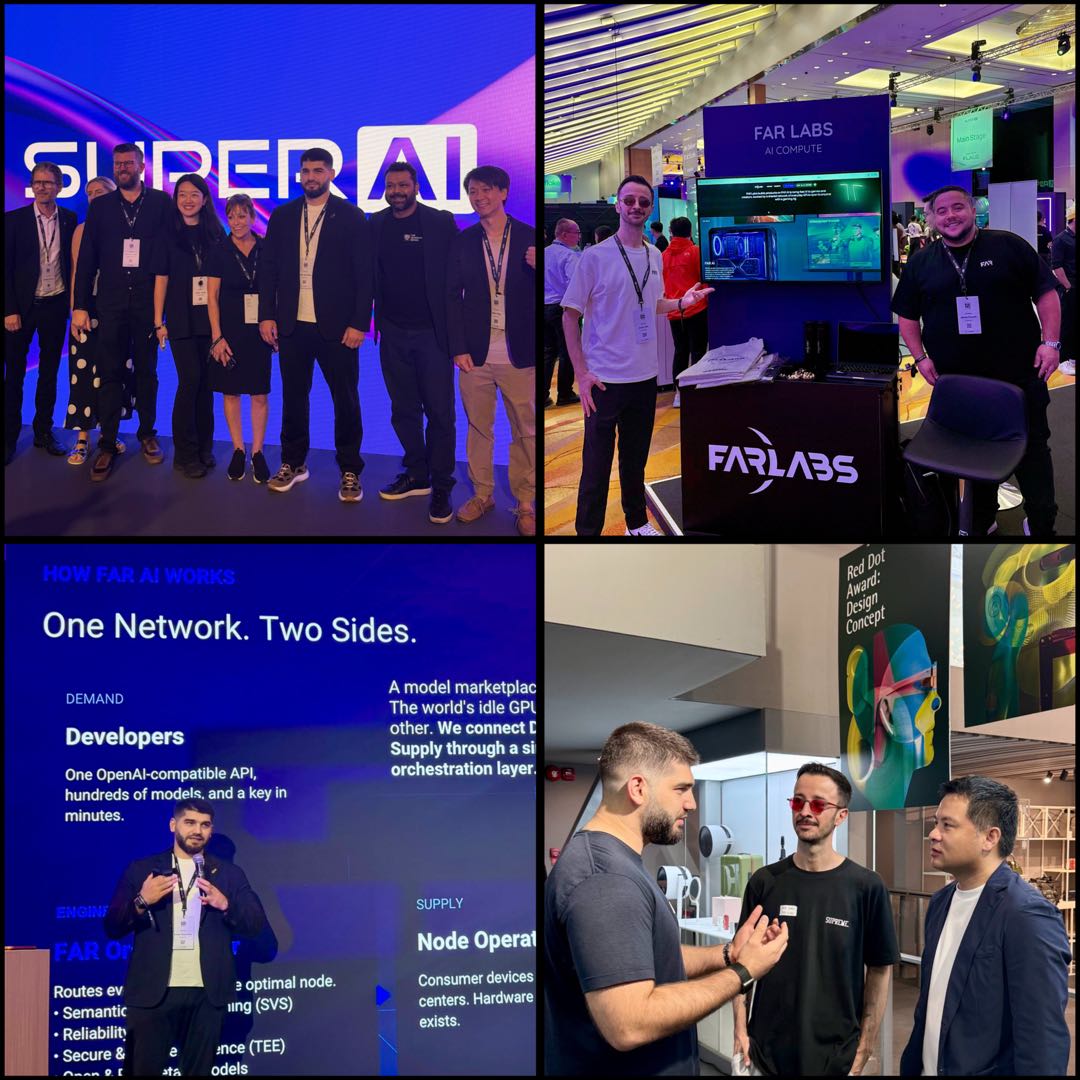
The team also showcased key products from the FAR Labs and Dizzaract ecosystem, including FAR AI, FAR Chat and GAMED powered by FAR AI.
• FAR AI introduced the core infrastructure layer, a distributed AI inference network designed to connect available compute capacity with developers and AI teams that need reliable, efficient and faster inference.
• FAR Chat showed how AI assistant experiences can be built within our ecosystem.
• GAMED powered by FAR AI showed how our infrastructure can support real products across Dizzaract’s wider ecosystem, connecting AI infrastructure with user-facing applications.
SuperAI Week by the Numbers
We mapped strong interest across both the supply and demand sides of the AI infrastructure market.
The team attended more than 20 side events and the main event and recorded:
• 100+ strategic conversations across the AI ecosystem
• 60+ potential customer and partner conversations
• 40+ GPU and model provider, enterprise buyers, large companies and ecosystem conversations
These numbers showed clear interest across both sides of the network: compute providers looking to activate available capacity and AI builders looking for low-cost, reliable, efficient and faster inference infrastructure.
What SuperAI Confirmed for FAR Labs
One of the biggest takeaways from SuperAI was the level of alignment around our core thesis. The AI industry does not only need more compute. It needs better ways to connect the compute that already exists with the people and companies that need it. A large amount of GPU capacity already exists across cloud platforms, data centers, workstations and consumer-grade hardware. At the same time, AI inference demand continues to grow as more developers, startups, enterprises and products bring AI into real usage.
That gap is where FAR AI is focused. The platform is designed to coordinate distributed compute supply and connect it with developers and AI teams that need inference capacity. It brings together compute availability, routing, verification, reliability and performance into one infrastructure layer. In simple terms, FAR AI helps turn available GPU resources into useful infrastructure for AI inference.
The Strongest Market Signal: Low-Cost, Reliable and Efficient Inference
One message consistently captured attention throughout the week: FAR AI is building the lowest-cost, reliable and efficient inference infrastructure for AI builders.
For developers and AI companies, the value is easy to understand. As AI products grow, inference can become one of the largest recurring infrastructure costs, especially for applications using AI agents, high-volume user requests, multiple model calls, batch processing or customer-facing AI workflows.
For infrastructure providers and GPU owners, the value is also clear. Available hardware can become productive when it is connected to real demand through the right routing, verification and reliability layer.
That is why the model resonated across both sides of the market. It is not only focused on making inference more affordable. It is designed to make inference more reliable, efficient and scalable by coordinating available GPU resources and routing workloads through a performance-focused infrastructure layer.
The cost advantage comes from a different infrastructure model: activating available compute and connecting it with real AI workloads.
Supply and Demand Were Both Present
The event confirmed demand on both sides of the network. We met infrastructure providers and GPU owners interested in contributing available capacity. We also met developers, software companies, model teams and enterprises looking for more efficient ways to access compute.
This dual-sided interest is important because a strong inference network needs both sides to move together. For supply partners, it creates a path to make available GPU capacity productive. For developers and AI companies, it creates a path to access inference infrastructure designed around cost efficiency, reliability and scale.
This is one of our strongest advantages: we are not only speaking to one side of the market, we are building the touchpoint between both.
What the Market Is Asking For
The event showcased that the market is not only looking for basic inference access. Many conversations pointed toward broader infrastructure needs, including reserved GPU capacity, dedicated instances, custom model deployment, fine-tuning and prompt caching.
In simpler terms, companies are asking for infrastructure that fits how they actually build, test, deploy and scale AI products. Some teams want to run existing models more efficiently, some want dedicated or reserved GPU capacity, some want to deploy their own models, some want fine-tuning workflows or some want stronger privacy, monitoring and enterprise routing options.
This feedback gives us a strong product signal: the market sees FAR AI not only as an inference network, but as a foundation for broader AI infrastructure services.
Trust, Privacy and Reliability Matter
Another clear learning from SuperAI was that serious infrastructure buyers care about trust as much as price. Low cost gets attention but reliability builds confidence. Enterprise teams and infrastructure buyers asked important questions around uptime, support response times, data handling, certifications, routing options, monitoring and accountability. This is a natural part of moving from early interest to enterprise adoption.
For us, this feedback is valuable because it shows where the next layer of product and commercial readiness matters most. Enterprise customers need to understand how workloads are routed, how data is protected, what service levels are available and how reliability is maintained across the network. As the platform continues to grow, these areas will remain central to the infrastructure roadmap.
Key Conversations Across the AI Ecosystem
Across SuperAI Week, our team held conversations with teams and representatives across cloud, model, infrastructure, investor, enterprise and developer categories. These included discussions with teams connected to Google Cloud and Gemini, Alibaba Cloud and Qwen, Z.ai and GLM, Manus AI, Akamai Technologies, Aethir and other companies across the AI infrastructure ecosystem.
The conversations reinforced a clear market direction: model providers need more distribution and testing environments, developers need reliable and efficient inference, enterprises need trusted infrastructure and compute providers need better utilization of available capacity. These needs are connected, they are part of the same infrastructure challenge. Our network is being built to help connect them.
What We Learned
SuperAI Singapore gave us several important learnings.
First, the GPU supply challenge is widely understood across the industry. Market participants quickly recognized the value of activating available hardware instead of depending only on new infrastructure buildouts.
Second, demand for inference is becoming broader and more urgent. Developers, startups, model providers and enterprises are all looking for better ways to run AI workloads efficiently.
Third, companies with live AI workflows feel the strongest need today. Teams already running AI products immediately understand the importance of cost, reliability and scalability because they are already dealing with real usage.
Fourth, reliability and privacy are essential for enterprise adoption. The market wants low-cost inference, but it also wants clear documentation, strong routing options, service commitments and data protection.
Fifth, the next generation of AI infrastructure will be defined by coordination. Compute already exists across many environments. The opportunity is to organize it, verify it and deliver it where it is needed most.
For us, these learnings strongly aligned with the direction of FAR AI.
What We Gained
The event helped us strengthen three key areas.
The first was market validation. Conversations across the ecosystem confirmed that FAR AI is addressing a real and timely infrastructure need.
The second was ecosystem momentum. The team built new relationships across cloud, infrastructure, model provider, investor, enterprise and developer categories.
The third was strategic direction. SuperAI helped sharpen where we can create the most value: connecting compute supply with AI inference demand through a reliability-focused infrastructure layer.
The week also opened opportunities for future developer programs, infrastructure benchmarking, model provider collaboration, enterprise supply pilots and demand-side partnerships.
Most importantly, it confirmed that FAR AI has relevance on both sides of the market. For compute and infrastructure providers, the network creates a path to make available capacity productive. For developers and AI companies, it creates a path to access inference capacity through a distributed network designed around cost efficiency, reliability and performance.
What We Are Taking Forward
Following SuperAI Singapore, we are continuing conversations across infrastructure, model, developer, investor and enterprise segments. The next focus is to expand technical validation with ecosystem partners, strengthen supply-side relationships, support developer access and continue building FAR AI as a production-ready infrastructure layer for inference.
The team is also taking forward key market feedback around reserved GPU capacity, enterprise service levels, data privacy, custom model deployment, fine-tuning and prompt caching. These insights will help shape how FAR AI evolves from a low-cost inference network into a broader infrastructure layer for AI builders.
It made one thing clear: the market is not only asking for more compute. It is asking for smarter access to compute. It is asking for infrastructure that can connect supply and demand, asking for systems that can make available resources more useful, more reliable and easier to deploy. That is the future we are building towards.
Building the Coordination Layer for AI Inference
The future of AI will not be shaped by models alone. It will also be shaped by the infrastructure that makes those models usable at scale. As inference demand continues to grow, the industry will need systems that can coordinate compute more intelligently across different sources, providers and environments.
SuperAI Singapore 2026 made that direction clear. The week confirmed the opportunity ahead: to build infrastructure that connects global compute supply with the AI builders, developers and enterprises that need it.
The next phase of AI infrastructure will not only be about how much compute exists. It will be about how efficiently that compute is discovered, verified, routed and delivered where it is needed most. That is where FAR AI comes in. It is building low-cost, reliable, efficient and faster inference infrastructure for the next generation of AI applications.